Social preservation ordinances are in force in 82 Berlin areas today. Anyone who owns a building there, or wants to buy one, is not dealing with a single rule but with several layers of regulation that partly overlap – and two of them have changed in this year alone. This article sets out what applies, what is new, and what follows from it for valuation.
Please note: This article reflects the legal position as at September 2026. It is a general account for owners and prospective buyers and replaces neither an examination of the individual case nor legal or tax advice. The periods and ordinances cited change frequently; the binding source is always the information given by the competent district authority.
What is a preservation area?
An area in which the district makes demolition, structural alteration and change of use subject to a separate approval requirement – in addition to building regulations law, and independently of it.
The legal basis is § 172 of the Federal Building Code (Baugesetzbuch, BauGB). The provision recognises three variants, which are frequently confused in practice:
- No. 1 – urban-design preservation ordinance. Protects the urban-design character of an area, essentially its appearance. Here new construction also requires approval.
- No. 2 – social preservation ordinance. Protects the composition of the resident population. This is “Milieuschutz”, the subject of what follows.
- No. 3 – preservation during urban restructuring. Not yet applied in Berlin.
One point of terminology first: the statute speaks of a preservation Satzung (by-law). Berlin, however, is a city-state and has no municipal by-laws – here the districts issue Rechtsverordnungen (ordinances). The official dataset is therefore called “Erhaltungsverordnungsgebiete”. The meaning is the same.
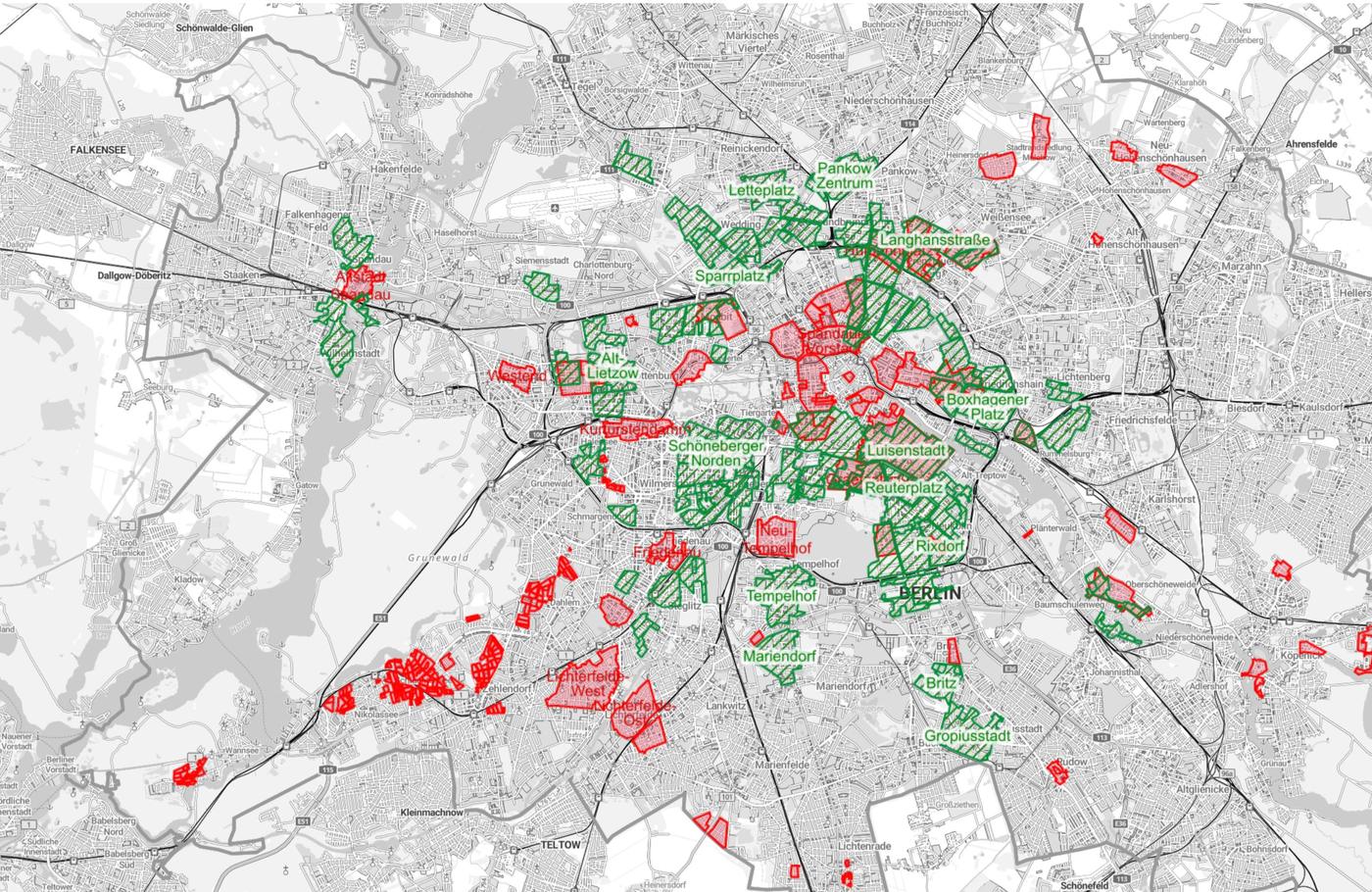
- Social preservation areas – § 172 (1) sentence 1 no. 2 BauGB (“Milieuschutz”)
- Urban-design preservation areas – § 172 (1) sentence 1 no. 1 BauGB
What matters about no. 2 is its aim: what is protected is not the individual tenant but the structure of a quarter's resident population. The district of Friedrichshain-Kreuzberg puts this unambiguously on its own pages – preservation law is an urban-planning instrument and, unlike tenancy law, offers no protection to individual tenants. For owners this has an uncomfortable consequence: it does not help to point out in the approval procedure that the tenant concerned consents to the measure.
Scale
In response to a parliamentary question, the Senate stated in spring 2026 that Berlin has 82 social preservation areas containing 664,504 dwellings and 1,198,619 registered residents (as at 31 December 2024). Measured against 2,058,666 dwellings and 3,897,145 inhabitants across the whole city, roughly one third of the housing stock is therefore under Milieuschutz. The map is still growing: in March 2026 the district of Reinickendorf resolved to initiate ordinances for four further sub-areas.
One distinction matters here that sales particulars regularly blur. The publicly announced resolution to initiate an ordinance (Aufstellungsbeschluss) does not itself bring a preservation ordinance into force. However, § 172 (2) BauGB, in conjunction with § 15 BauGB, allows applications to be deferred in order to secure the intended preservation objectives – for a limited period, initially twelve months in Reinickendorf. The Berlin administrative rules on approval criteria expressly apply to areas with such a resolution as well. A mere study, observation or candidate area has none of these effects.
For a buyer, though, the difference is only one of timing. Where an in-depth study is under way, the initiating resolution can follow within a few months – in Reinickendorf it was passed before the corresponding study was even completed in May 2026. Anyone buying there is calculating against a legal position that does not yet apply but is foreseeable.
Which measures require approval?
Demolition, alteration and change of use of structures – including vacant flats and including owner-occupied condominium units.
The preservation-law approval requirement is a free-standing test. It applies regardless of whether the project requires a building permit under the Berlin Building Code, is exempt from the permit procedure, or is procedure-free altogether. This is the most common source of error: a project needing no building application may still require a preservation-law application.
Under the administrative rules in force, the following are not covered:
- the erection of structures (new build),
- maintenance measures within the meaning of § 555a of the Civil Code (BGB), that is, straightforward upkeep and repair,
- changes to the fit-out of a dwelling that do not involve a structural alteration,
- measures that are from the outset incapable of endangering the protective objective. Whether that is so, however, is assessed by the district – not by the owner.
The competent body is the urban development office of the relevant district. Where a building permit is required, the building supervisory authority grants the approval and involves the planning department; in all other cases the planning department decides itself.
How does the district assess an application – and who bears the burden of proof?
In three stages – the first two each examining a separate entitlement to approval, with only the third concerning refusal. The burden of presentation and proof for the entitlements lies with the applicant.
- Entitlement under § 172 (4) sentence 3 no. 1 or no. 1a BauGB. No. 1: the alteration serves to establish the contemporary fit-out standard of an average dwelling. No. 1a: the alteration serves to meet statutory minimum energy requirements. If either applies, approval must be granted.
- Separate entitlement under § 172 (4) sentence 2 BauGB. Preserving the structure is no longer economically reasonable. Since April 2026 the administrative rules expressly require an expert report prepared in accordance with the principles developed for heritage protection law, demonstrating over a forecast period of roughly ten to twelve years that the costs of preservation exceed the achievable income. That is a high hurdle, but at least a clearly stated one.
- Refusal. Permissible only where the composition of the resident population is to be preserved for particular urban-planning reasons. Discretion must be exercised where there are indications of an atypical case – conditions and stipulations are then possible, and the interests of accessibility and climate protection must be given particular weight.
What changed in April 2026?
The approval criteria were completely recast. The administrative instructions of November 2024 ceased to apply on 18 April 2026 and were replaced by considerably more detailed administrative rules.
The new version is more generous than its predecessor in several respects, and noticeably stricter in one.
It has become more generous where living quality and climate protection are concerned. The first-time addition of a balcony is now approvable in a standard design, as is a level-access shower when a bathroom is first installed and, in the context of refurbishment that is permissible anyway, threshold-free floors and doors. For lifts the familiar basic rule above four storeys remains, but it is for the first time underpinned by verifiable figures: thresholds drawn from an annually published construction-cost schedule, technical specifications for a standard lift, and area-specific rent-burden thresholds for assessing displacement risk. From 1 July 2026 a separate regime applies to replacing a heating system: if the new installation meets the statutory minimum energy requirements and the existing one is at least fifteen years old, replacement is in principle approvable – demonstrated need for renewal of the old system is then no longer a precondition.
It has become stricter on letting. Fixed-term or furnished letting of accommodation previously let on an open-ended basis now counts in principle as a change of use and therefore requires an application. Broadly, only the statutorily permitted fixed term under § 575 BGB and the subletting of one's own registered residence remain approvable.
This is the point with the greatest economic effect. Furnished short-term letting has recently been the valve through which many owners in Milieuschutz areas worked around effectively capped sitting rents. That valve is now expressly addressed, together with a list of indicators: the term of the contract, furnishing, the tenant's housing need, a pre-formulated fixed term, short-notice termination rights, the rent level, the registered address, additional services. Anyone buying a building with a significant share of furnished units in a preservation area should not carry that share of income into the calculation unchecked.
The full catalogue of measures – floor plans, windows, floors, sanitary fittings, lifts, balconies, heat supply, photovoltaics, temporary letting – is set out in the administrative rules themselves. They are short, clearly structured and readable for owners (in German):
Senate Department for Urban Development, Building and Housing – Soziales Erhaltungsrecht
VV Genehmigungskriterien soziale Erhaltungsgebiete of 7 April 2026, Official Gazette for Berlin no. 16 of 17 April 2026, p. 926 ff.
Interpretation in the individual case rests with the urban development office of the relevant district. A preliminary discussion there costs nothing and regularly saves a hopeless application.
An open flank: federal law and the Berlin rules have diverged
The Berlin administrative rules date from 7 April 2026. For heating replacement from 1 July 2026 they make approvability expressly conditional on the new installation complying with “the requirements of § 71 (1) GEG” and the existing installation being at least fifteen years old. Three months later the reference provision changed: the Building Modernisation Act (Gebäudemodernisierungsgesetz) was promulgated on 28 July 2026, §§ 71 ff. of the Building Energy Act (GEG) with their 65 percent renewables requirement were repealed with effect from 29 July 2026, and the GEG has since been renamed the Gebäudemodernisierungsgesetz.
The Federal Building Code was brought into line. In the version in force since 29 July 2026, § 172 (4) sentence 3 no. 1a BauGB refers expressly to the minimum requirements of the Gebäudemodernisierungsgesetz – amended by Article 8 of the Act of 23 July 2026. The federal entitlement to approval therefore stands.
What was not brought into line is the Berlin administrative rule. It still refers to a provision that no longer exists in that form. This does not devalue the entitlement – the statute governs, not the administrative rule – but it does create room for interpretation as to what the districts now measure the first of the two conditions against. Anyone planning to replace a heating system in a preservation area should therefore base the application expressly on § 172 (4) sentence 3 no. 1a BauGB as currently in force, rather than on last year's practice.
Conversion: why § 250 BauGB matters more than § 172
Because the federal rule takes precedence – and catches virtually every apartment building. It applies city-wide to buildings with more than five dwellings, until the end of 2030.
Two ordinances sit on top of one another here. The conversion ordinance under § 250 BauGB has been in force since 1 January 2026 and runs until the end of 2030, designating the whole of Berlin as an area with a strained housing market; for existing residential buildings with more than five dwellings, creating condominium ownership is therefore prohibited in principle. The Conversion Ordinance 2025 under § 172 BauGB applies in the social preservation areas until March 2030, but since January 2026 only to buildings with up to five dwellings.
For a typical apartment building this means that § 250 BauGB governs, not Milieuschutz – and that rule applies throughout the city in any event. The effect is considerable. According to Senate figures, the number of completed conversions fell from 28,783 dwellings in 2021 to 1,552 dwellings in 2024.
Approval is granted, among other cases, on the division of an estate in favour of co-heirs, on sale for owner-occupation within the family, in cases of hardship – and where at least two thirds of the tenant households acquire their own flat. For the last of these a declaration of intent is not enough: notarised purchase contracts conditional upon approval must be submitted.
Where a conversion does take place, § 577a BGB applies. Berlin has extended the notice-protection period to ten years city-wide, most recently by the Kündigungsschutzklausel-Verordnung of 13 June 2023, which runs until the end of September 2033. The period begins with the first sale following conversion and continues to run unchanged through every subsequent change of owner – a resale does not start it afresh. Anyone buying a converted, tenanted flat for their own use must therefore establish when the period actually began, not when they themselves bought.
Pre-emption rights: what is left of them
Little – and that may change. Pre-emption rights have scarcely been exercised since 2021; a reform has been before the Bundestag since May 2026.
On 9 November 2021 the Federal Administrative Court (BVerwG, 4 C 1.20) held that § 26 no. 4 BauGB excludes pre-emption, including in social preservation areas, where the property is currently developed and used in accordance with the objectives of the ordinance. What counts is the actual state of affairs, not the buyer's presumed intentions. The Senate Department states the consequence itself: pre-emption rights can now be exercised only in a few particular cases.
Two points remain relevant in practice. First, older cases continue to run: avoidance agreements (Abwendungsvereinbarungen) from the years 2015 to 2021 were not automatically rendered ineffective by the judgment. Whether such an agreement continues to have effect, and whether it binds a later purchaser, depends on the particular contract. Its existence and content should therefore be established before notarisation – from the district and from the seller.
Second, a reform is pending. The “BauGB upgrade” (Bundestag printed paper 21/6588) has been in the parliamentary process since May 2026, the public hearing is scheduled for 23 September 2026 and entry into force is planned for 1 January 2027. Among other things it provides for an extended pre-emption right in respect of problem properties and a new acquisition right intended to stop pre-emption rights being circumvented through share deals. This is a draft, not law in force – but anyone setting up a structure today whose economics rest on a later share deal should keep an eye on the process.
What does this mean for value?
Milieuschutz narrows income growth and closes off the conversion route – it therefore mainly lowers the upper end of the valuation range. The property does not become worse; it becomes more predictable.
The mechanics are straightforward. An apartment building in a preservation area loses essentially three sources of value:
- the conversion upside – which, as shown above, is in any case already constrained city-wide by § 250 BauGB;
- the modernisation potential – not entirely, but appreciably limited by the catalogue of approvable measures; alongside it, entitlements remain for energy-efficiency measures, for the contemporary fit-out standard and under the special rules on lifts, balconies, bathrooms and accessibility;
- the re-letting strategy – since April 2026 also in so far as it ran through furnished or fixed-term contracts.
In my experience, therefore, what determines the price is less the area than who is sitting at the table: a buyer calculating on upgrading and individual resale pays considerably less in Milieuschutz locations; a buyer looking for a long-term hold is troubled by it far less than the public debate would suggest.
- 82 social preservation areas in Berlin, 664,504 dwellings, 1,198,619 registered residents (as at 31 December 2024).
- Recast administrative rules on approval criteria have applied since 18 April 2026; city-wide uniform criteria have been in place since December 2024. They are more generous on balconies, bathrooms, accessibility and heating – and markedly stricter on fixed-term or furnished letting.
- For buildings with more than five dwellings, conversion into condominium ownership fails not because of Milieuschutz but because of § 250 BauGB, which applies city-wide. That ordinance runs from 1 January 2026 until the end of 2030.
- Following conversion and sale, a ten-year notice-protection period applies throughout Berlin.
- Pre-emption rights have largely fallen away since the 2021 Federal Administrative Court judgment. Older avoidance agreements may continue to have effect and belong in due diligence. The BauGB amendment with extended rights of access is in the parliamentary process; the hearing is scheduled for 23 September 2026.
- Senate Department for Urban Development, Building and Housing: VV Genehmigungskriterien soziale Erhaltungsgebiete of 7 April 2026, in force from 18 April 2026 (Official Gazette no. 16 / 17 April 2026, p. 926 ff.); previously AV Genehmigungskriterien of 18 November 2024
- Berlin House of Representatives, printed paper 19/25318, written question “Mehr Milieuschutz für Berlin – Stand 2026” of 24 February 2026, Senate reply of 11 March 2026 (82 areas, 664,504 dwellings, 1,198,619 residents as at 31 December 2024)
- District of Reinickendorf: resolution of 24 March 2026 to initiate ordinances for the sub-areas Schäfersee, Teichstraße, Breitkopfbecken and Hausotterplatz
- Conversion ordinance under § 250 BauGB (Senate decision of 11 November 2025, in force 1 January 2026, explanatory memorandum in Official Gazette no. 48 / 21 November 2025)
- Kündigungsschutzklausel-Verordnung of 13 June 2023 (GVBl. p. 228), in force since 1 October 2023
- Federal Administrative Court, judgment of 9 November 2021 – 4 C 1.20
- On the start of the period under § 577a BGB: Federal Court of Justice, judgment of 6 August 2025 – VIII ZR 161/24; Berlin Regional Court, judgment of 22 March 2013 – 63 S 356/12
- German Bundestag: draft Act on the modernisation of urban development and spatial planning law, printed paper 21/6588; hearing of the Committee on Housing, Urban Development, Building and Local Government on 23 September 2026
- Gebäudemodernisierungsgesetz, promulgated 28 July 2026; repeal of §§ 71 ff. GEG with effect from 29 July 2026. Consequential amendment of § 172 (4) sentence 3 no. 1a BauGB by Article 8 of the Act of 23 July 2026 (Federal Law Gazette 2026 I no. 226)
- §§ 15, 24, 26, 27, 172, 173, 250 BauGB; §§ 555a, 575, 577a BGB; Gebäudemodernisierungsgesetz
Status: September 2026. All information has been researched to the best of my knowledge on the basis of the sources named, but is given without warranty. Liability for decisions based on this general account is excluded. For an assessment of a specific property, please contact the competent district authority and a lawyer.