After the decline of 2022 to 2024, prices for pre-war apartment buildings moved sideways in 2025. In the city area the multiplier stands at around 23 annual net cold rents.
Basis and methodology
The analysis draws on the reports of the Berlin valuation committee (Gutachterausschuss für Grundstückswerte in Berlin, GAA) for the years 2014 to 2025; the 2025 figures come from the Property Market Report 2025/2026. What is shown is the normal structural condition of pre-war buildings (Altbauten): average maintenance condition, customary ongoing upkeep, and repair or modernisation carried out decades ago. Properties in good structural condition are not reported separately because case numbers are too low.
Two property categories are analysed, pure residential buildings without commercial use and mixed residential-and-commercial buildings, each split into the city area (“City”) and the rest of the city. The valuation committee takes “City” to mean roughly the area inside the S-Bahn ring, delimited by whole districts (Ortsteile); the rest of the city comprises all other districts. The division is geographical and says nothing about residential quality (basic to very good).
The current report states prices per m² of value-relevant floor area (wertrelevante Geschossfläche, wGF). I convert them to living space with a factor of 0.73 so that the series remains comparable from 2014; the same factor also yields the 2024 values of the earlier chart. For buildings up to 1919, the 2025/2026 report now gives roughly 72/100. With 0.72, all prices per m² of living space would be about 1.4% higher.
Purchase prices per m² of living space
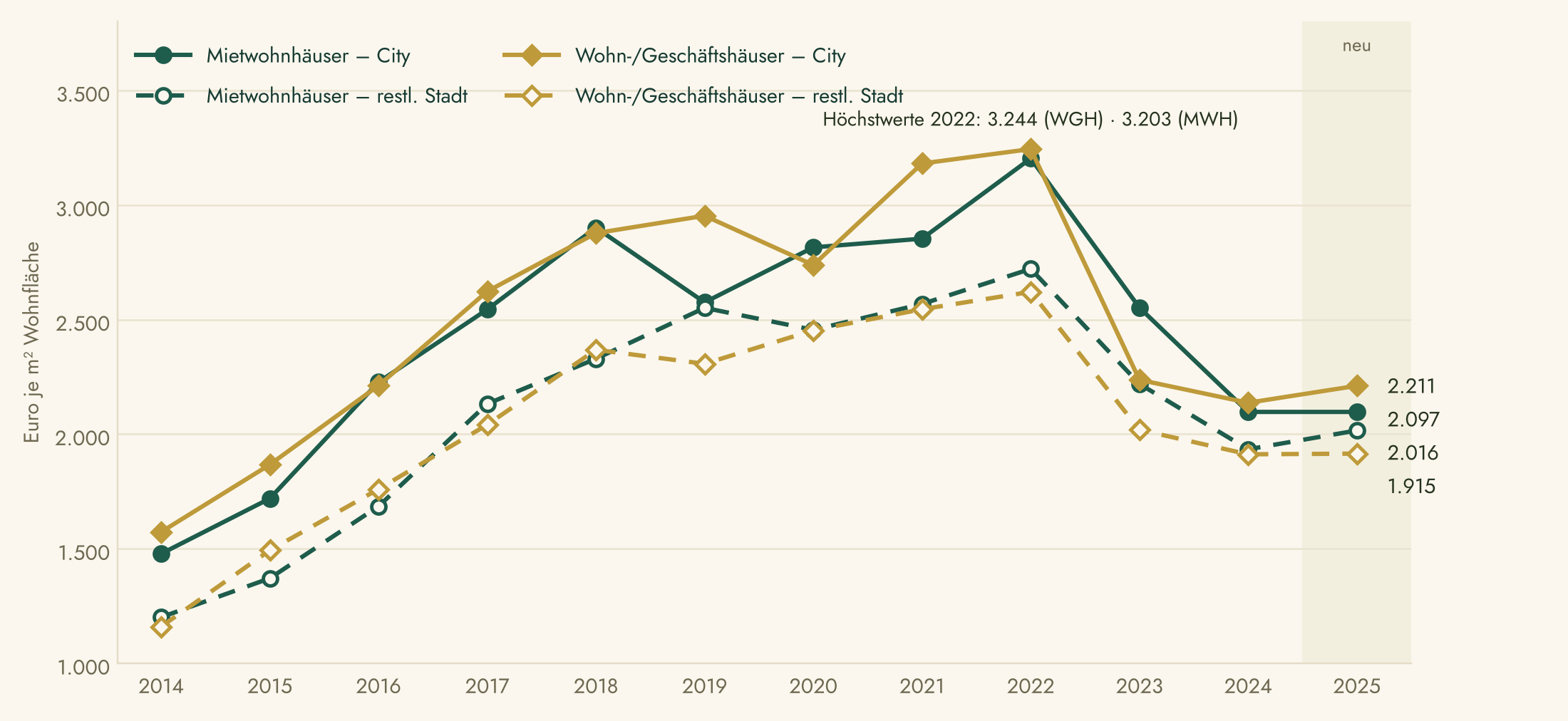
The chart shows the price per square metre of living space for both property categories and both areas. The city area achieves higher prices than the rest of the city in every year.
Observations and explanations
Growth phase 2014–2022: Prices rose in every category until 2022. Pure residential buildings in the city area climbed from around €1,478/m² to a peak of €3,203/m² (+117%). Mixed residential-and-commercial buildings in the city area reached their high of €3,244/m² in 2022.
Correction phase 2022–2024: Triggered by the sharp rise in interest rates, prices fell markedly. Building-loan rates rose from 1.00% at the start of 2022 to 3.78% at the start of 2023 and stood at 3.42% at the start of 2024, 3.15% at the start of 2025 and 3.85% at the start of 2026. By 2024, prices in the city area had fallen by around 35% (pure residential: €3,203 to €2,097/m²; mixed residential-and-commercial: €3,244 to €2,137/m²).
2025, sideways movement: Compared with 2024, prices remained almost unchanged. Pure residential, city area €2,097/m² (±0%), rest of the city €2,016/m² (+4%); mixed residential-and-commercial, city area €2,211/m² (+3%), rest of the city €1,915/m² (±0%). Compared with 2022, prices are therefore 26 to 35% lower. In the city area the level roughly matches 2016: mixed residential-and-commercial buildings stood at €2,212/m² then, pure residential buildings at €2,227/m². Case numbers 2025 (normal structural condition): pure residential 36 city area and 32 rest of the city, mixed residential-and-commercial 78 city area and 54 rest of the city.
City area versus rest of the city: In 2022 the city premium was around €480/m² (+18%) for pure residential buildings and around €620/m² (+24%) for mixed residential-and-commercial buildings. In 2025 it is €81/m² (+4%) and €296/m² (+15%) respectively. For pure residential buildings the gap has thus largely closed.
Multiplier of the annual net cold rent
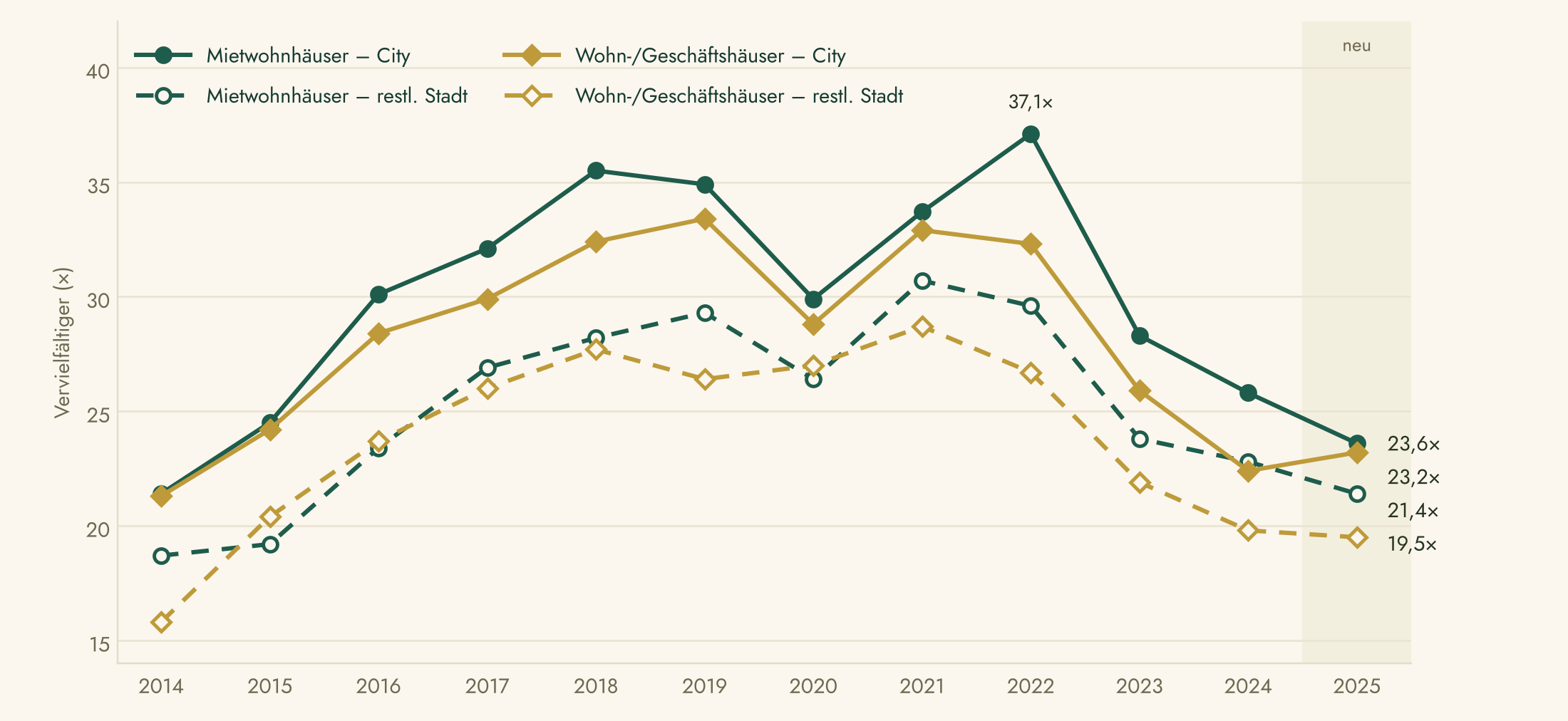
The multiplier (factor) indicates how many times the annual net cold rent was paid as the purchase price. A higher multiplier corresponds to a lower initial yield.
Observations and explanations
Peak in 2022: Pure residential buildings in the city area reached the highest multiplier at 37.1. That corresponds to a gross initial yield of around 2.7%. The historically low interest level (0.75 to 1.00%) still made these valuations financeable.
Decline 2022–2025: The multiplier for pure residential buildings in the city area fell from 37.1 to 23.6 (−36%); the gross initial yield rose to around 4.2%. It is thus below the 2015 value (24.5). For mixed residential-and-commercial buildings in the city area it fell from 32.3 (2022) to 23.2 (−28%), after 22.4 in 2024. In the rest of the city the values are 21.4 (pure residential) and 19.5 (mixed residential-and-commercial).
Pure residential buildings, city area, 2025: The price per m² stayed the same, while the multiplier fell from 25.8 to 23.6. Possible causes are higher rents in the properties sold or a different composition of the sample. The averages alone cannot prove this; with 27 cases with a multiplier, individual sales have a strong effect.
City area versus rest of the city: The rest of the city has consistently lower multipliers. In 2025 the gap is 2.2 points for pure residential buildings and 3.7 points for mixed residential-and-commercial buildings; across 2014 to 2025 it varies between 1.8 and 7.5 points. This points to higher yield expectations among investors outside the city area.
Outlook 2026 (preliminary)
For the first quarter and the first half of 2026, the valuation committee has published preliminary turnover figures. They apply to all construction years and the entire city area and are not directly comparable with the charts.
| Sub-market | Purchase cases H1 2026 | Average price level Q1 2026 | Average price level H1 2026 |
|---|---|---|---|
| Pure residential buildings (without commercial use) | 168 (−12%) | −14% | −4% |
| Mixed residential-and-commercial buildings | 128 (−4%) | −2% | +1% |
Change compared with the same period of the previous year. Pure residential buildings: average purchase price per m²; mixed residential-and-commercial buildings: per m² wGF. Source: GAA Berlin, preliminary turnover figures Q1 2026 (published 15 June 2026) and H1 2026 (published 3 September 2026); includes purchase contracts submitted to the valuation committee by 10 May (Q1) and 15 August 2026 (H1) respectively.
The decline for pure residential buildings was smaller in the first half (−4%) than in the first quarter (−14%). The valuation committee itself points out that, given the low case numbers, individual high-priced or large-area properties can strongly influence the average. The values therefore need to be assessed by an expert.
Outlook winter 2026/27: interest rates and Berlin politics
Status: 3 November 2026. The assessments in this section are speculation. Reliable purchase-price data for the period after the election will be available at the earliest in early 2027.
Interest rates: Building-loan rates (10-year fixed, Interhyp, each as at 1 January) stood at 3.15% at the start of 2025 and 3.85% at the start of 2026. In October 2026 Interhyp quotes an average of around 4.4% (update of 15 October 2026), i.e. about 0.5 percentage points more than at the start of the year. The ECB raised its key rate by 0.25 percentage points each in June and September 2026. Depending on lender and loan-to-value ratio, figures vary: the comparison calculator baufivergleich shows 3.90 to 4.33% at the end of October.
Politics: In the Berlin House of Representatives election on 20 September 2026, Die Linke became the strongest party for the first time with 25.7% of second votes, ahead of the CDU (18.8%), AfD (16.3%), Greens (14.3%) and SPD (12.1%) (provisional final result, per bpb). According to ZDFheute (end of October 2026), Linke, Greens and SPD agreed in exploratory talks on the socialisation of large housing portfolios: around 160,000 flats owned by companies with at least 10,000 flats, compensation of at most €16 billion. The law is to be passed in 2028 and enter into force a year later, subject to review by the Federal Constitutional Court. No coalition agreement exists yet. Apartment buildings owned by private owners below the 10,000-flat threshold are, on the state of the exploratory talks, not directly affected; effects arise rather indirectly via financing, expectations and possible further regulation.
Voices from the market
Expectations, not primary data.
Association of German Pfandbrief Banks (VDP), Jens Tolckmitt, 22 October 2026 (per dpa): If land charges were to lapse without replacement on socialisation, as the initiative “Deutsche Wohnen & Co. enteignen” envisages, this would hit low-cost secured property financing; borrowers would have to pay higher interest. Banks were already holding back. The VDP represents the interests of the lending industry here.
Flash survey by Georg Ortner (Makler Service AG, 30 October 2026): 414 property professionals from Germany, Austria and Switzerland; selection and survey period are not documented. 87% expect capital to withdraw from Berlin, 14% consider actual socialisation by 2031 likely. 56% of the Berlin brokers surveyed report concrete client reactions since the election; purchase and investment decisions are being postponed. The survey gives no price figures.
CBRE (German residential investment market, 26 October 2026): Transaction volume from January to September stood at just under €5.9 billion nationwide, around 4% below the same period of the previous year; around €2.3 billion in Q3. The prime yield for apartment buildings in the top-7 cities rose by 0.2 percentage points to 3.59%. Price discovery remained difficult, with many sales processes being renegotiated, adjusted or postponed. Berlin remained the largest residential investment market; the socialisation debate was raising the need for scrutiny, above all among risk-averse investors. These are predominantly portfolio deals, not the market for smaller apartment buildings.
Handelsblatt (1 November 2026): Market participants are quoted on large investors: “Capital is shy” (Konstantin Lüttger, Newmark); some foreign investors expect the plans to fail and keep investing, others are unsettled. Heimstaden is withdrawing from Berlin. A general collapse in demand has not been documented so far. That large owners might sell individual flats and thereby depress prices is mentioned as a possibility, not as a documented trend.
IW Köln (study commissioned by Berliner Sparkasse, Berliner Volksbank, DKB and IBB, June 2026): Expects investment restraint in new build and existing stock as well as risk premiums or stricter lending by banks. The study does not quantify prices; apartment buildings of smaller owners are not examined separately. The commissioning parties are themselves lenders.
IHK Berlin/BFW (survey before the election, as reported by Börse Express, 24 October 2026): 37% of the companies surveyed have put investments on hold, affecting among others 1,630 planned purchases of existing buildings.
GAA Berlin (preliminary turnover figures H1 2026, as at 3 September 2026, before the election): Pure residential buildings 168 purchase cases (−12%), turnover €520.3 million (−19%), average price level −4%; mixed residential-and-commercial buildings 128 purchase cases (−4%), turnover €674.8 million (+17%), price level +1%. Figures for the period after the election are not yet available.
On the question of targeted discounts: For apartment buildings of smaller owners I have found no reliable source that proves or disproves discounts after the election. In the portfolio segment, CBRE reports frequent renegotiations and postponements, which is an indication of price pressure. The Ortner survey names clients who are waiting. Both point first of all to lower turnover and more negotiating pressure on sellers; whether sellers actually give way will only be shown by completions in Q4.
Assessment (speculative)
Interest rates work through the yield spread. As a worked example: a multiplier of 21 corresponds to a gross initial yield of around 4.8%, about 0.9 percentage points above the building-loan rate at the start of 2026 (3.85%). If that spread stayed the same at a 4.4% building-loan rate, the yield would be around 5.3%, corresponding to a multiplier of around 19 (−10%). This is a worked example and an upper bound, not a forecast: rent increases, more equity or falling interest-rate expectations can dampen the effect.
Politics works through risk premium and waiting. Until a law has been passed (planned for 2028) and clarified under constitutional law, the situation remains open. In the meantime buyers may demand a premium and banks may finance Berlin properties more cautiously. Against this: apartment buildings of small owners are not covered by the plans, and rents in the existing stock could keep rising.
Behaviour: Typically turnover falls first, with prices following with a delay and selectively. Sellers under no pressure wait. Where there is pressure to sell, for instance owing to a community of heirs, refinancing or age, discounts are more readily enforceable. Properties with a maintenance backlog or difficult financeability are likely to be hit harder.
| Scenario (assumptions, not a forecast) | Interest rates / politics | Prices in 12 months |
|---|---|---|
| A: Sideways | Building-loan rate 4.2 to 4.6%; exploratory talks without further consequences for apartment buildings | 0 to −3% (2026 trend), turnover low |
| B: Interest-rate adjustment | Building-loan rate above 4.5%; investors maintain the yield spread | arithmetically up to around −10% |
| C: Political risk premium | Banks make Berlin loans more expensive; investors shift to other cities | Discounts above 10% for Berlin properties, turnover still low |
A mixture of A and B seems most plausible to me; C remains a risk. Leading indicators are the preliminary full-year 2026 figures of the valuation committee (early 2027), the development of interest rates, the coalition agreement and the question of whether the federal government will limit socialisations by the states by law.
Conclusion
After the boom of 2014 to 2022, the Berlin market for pre-1919 buildings has gone through a marked correction. Since the 2022 peak, purchase prices per m² of living space are 26 to 35% lower, and the multiplier in the city area 28 to 36%. In 2025 the decline did not continue; in the city area prices moved at roughly the level of 2016. The preliminary figures for 2026 still show no recovery for pure residential buildings. The decisive factor behind the correction was the rise in interest rates: building-loan rates rose from 0.75% (2021) to 3.78% (2023), stood at 3.42% at the start of 2024 and 3.15% at the start of 2025. At the start of 2026 they were back at 3.85%, and in October 2026 at around 4.4%. The rise in interest rates and political uncertainty point more against a rapid recovery; reliable data on this will only be available from early 2027. Despite the correction, prices in the city area remain well above the 2014 level (pure residential, city area: €2,097 versus €1,478/m², +42%).
Status: November 2026. This analysis reflects general market data and is not a substitute for a valuation report by a publicly appointed and sworn expert.